Available Editions
Choose your preferred language / 选择您偏好的语言
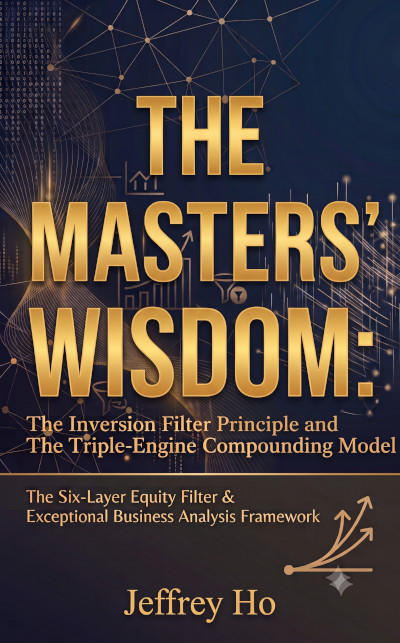
The Masters' Wisdom: The Inversion Filter Principle and The Triple-Engine Compounding Model
Foreword: Modernizing Value Investing for the Digital Era
This book pays homage to the architects of value investing: Mr. Benjamin Graham, Mr. Warren Buffett, and Mr. Charlie Munger and the pioneers who established the foundations of value investing.
This book seeks to address several foundational questions that have long driven my research: How can the mechanics of compounding be applied directly to corporate finance? Which operational drivers genuinely catalyze long-term growth? What fundamental mechanisms enable great enterprises to navigate economic cycles? And ultimately, what defines a "wonderful business"—as envisioned by Mr. Munger—and how can we synthesize disparate classical theories into a unified, systematic framework?
The analytical framework that follows is the culmination of years of research and reflection.
I. The Foundational Code of Investing: Understanding the Compounding Equation
The thesis of this book is rooted in mathematical logic. In Part I, I establish the compounding equation as the cornerstone of this system, analyzing compounding as the primary driver of capital appreciation. Compounding is not an abstract philosophy; it is a rigorous science governed by three primary variables:
- Rate of Return: Your return reflects your skill, analytical rigor, and edge as investors. While higher returns naturally speed up wealth creation, this is also the most unpredictable variable. Chasing outsized gains quickly adds unnecessary complexity and downside risk.
- Time: The greatest multiplier of wealth. When paired with disciplined risk management, long holding periods give compounding the runway to do the heavy lifting. Given enough time, even a single upfront investment can snowball into lasting wealth without adding another dollar.
- Principal: This is the one variable you fully control. How much you put in—and how consistently you do it—comes entirely down to your own financial capacity, goals, and discipline.
Together, these three variables form the mathematical foundation of investing—and reveal a deeper truth: compounding is a lifelong personal discipline.
As Mr. Munger famously observed, understanding both the power of compound interest and how hard it is to achieve is the heart and soul of understanding life itself. Compounding is about far more than just accumulating money. It acts as a mirror, asking us to look at our knowledge, our careers, our spending habits, our health, and our long-term goals. In the end, every choice we make feeds back into our personal compounding equation—shaping the life we build. Done right, a sound investment philosophy brings peace of mind today and becomes a lasting legacy for generations to come.
II. Overcoming Investor Biases and Understanding the Limits of Scale
With the principles of compounding in place, the next step is applying them to real-world stock selection. However, many investors struggle to bridge classic value investing concepts with modern business realities, where underlying business models have fundamentally changed.
Traditional investing literature often praises "economic moats" while ignoring the cost of physical growth. Impressive historical returns make for great case studies, but they frequently gloss over just how hard and expensive it is to scale capital-heavy businesses. In practice, expanding a physical footprint often triggers disproportionate increases in complexity and overhead—leading to significant capital expenditures, administrative bloat, and geographic constraints that compress growth margins.
On the flip side, modern software and asset-light platforms play by entirely different rules. By scaling through code and leverage on third parties rather than physical infrastructure, they sidestep the heavy overhead and margin squeeze that weigh down legacy businesses.
Digital platforms play by a completely different set of rules. Powered by software, global distribution, and near-zero marginal costs, they scale rapidly without the burden of heavy physical assets. Instead of running into bottlenecks as they grow, they actually gain operating leverage—expanding their margins and throwing off massive Free Cash Flow.
Modern digital and asset-light businesses operate on completely different economics. Because they scale through software rather than physical infrastructure, they avoid the heavy overhead and shrinking margins that burden traditional companies.
- The Modern Value Trap: Fixating on low Price-to-Book (P/B) ratios and physical assets is a classic mistake. By overlooking how digital businesses scale without physical limits, investors miss out on the best compounding machines of our time.
- The Growth Trap: Chasing flashy storylines and top-line user growth often blinds investors to basic financial discipline. Scaling an audience is meaningless unless management translates that growth into smart capital allocation, aggressive buybacks, and real long-term EPS compounding.
This book bridges that gap—showing how great companies overcome scaling limits to unlock true long-term compounding engines.
III. The Masters' Wisdom: The Inversion Filtering Principle and the Triple-Engine Compounding Model: A Tribute to the Trio of Value Investing
To bridge classic value investing with modern business reality, this book presents a unified stock selection methodology. Building directly on the foundational principles of Mr. Graham, Mr. Buffett, and Mr. Munger, this framework adapts timeless value principles for the digital age.
The book is organized into three primary sections:
- Part I: The Compounding Equation — Explores the math and mechanisms behind long-term exponential growth.
- Part II: Business First, Market Second — Introduces The Masters' Wisdom: The Inversion Filtering Principle—a risk management model that systematically identifies and avoids major operational and market risks.
- Part III: Overcoming Scale Bottlenecks and the Triple-Engine Compounding Model — Dissects the physical constraints that stall corporate growth and explores how modern business models bypass them. It introduces the Triple-Engine Compounding Model—a blueprint for identifying exceptional businesses—and uses it to reframe Berkshire Hathaway’s core investment strategies.
Our risk management framework traces directly back to Mr. Graham. He gave us the margin of safety and taught investors to view Mr. Market as an emotional counterpart rather than a guide. Graham’s core discipline—estimating intrinsic value to protect against downside risk—forms the bedrock of our Six-Layer Equity Filter selection matrix.
On the business side, Mr. Buffett’s shareholder letters cut through corporate complexity. His principles—economic moats, capital allocation, and staying within a circle of competence—provide clear boundaries for filtering out fragile businesses. Combining his focus on capital deployment with my own background in software scaling helped shape the strict business rules that eliminate companies bound by physical growth limits.
At the execution level, our filtering framework relies directly on Mr. Munger’s art of inversion: "Invert, always invert."
The Inversion Filtering Principle translates the timeless wisdom of Mr. Graham, Mr. Buffett, and Mr. Munger into a practical Six-Layer Equity Filter system. Rather than trying to predict future winners, we establish strict rules to actively identify and eliminate potential failure points. Following Mr. Munger’s core lesson—that avoiding stupidity is easier than seeking brilliance—we systematically filter out high-risk value traps, leaving behind a portfolio of truly exceptional companies.
Applying the Triple-Engine Compounding Model helps us filter standard quality businesses down to those with truly durable moats. Under normal conditions, these exceptional compounders rely on three primary growth engines:
- Engine 1 (Operations): Asset-Light Scaling — Harnessing operating leverage and external resources to neutralize diseconomies of scale.
- Engine 2 (Business Model): Built-in Inflation Protection — Capitalizes on pricing power and nominal growth to outperform inflation and drive long-term compounding.
- Engine 3 (Capital Allocation): Value-Accretive Owner Returns — Efficiently deploying Free Cash Flow into dividends and share buybacks, driving compounding on a per-share basis.
To understand how these engines compound value, consider the fundamental formula for Earnings Per Share (EPS):
EPS = Net Income ÷ Total Shares Outstanding
While Engines 1 and 2 compound the numerator (Net Income), Engine 3 systematically shrinks the denominator (Total Shares Outstanding)—accelerating EPS growth beyond what top-line expansion alone can achieve.
Exceptional businesses rarely depend on external capital—and when they do deploy it, they achieve high returns. Asset-light digital platforms illustrate this perfectly: once they clear initial hurdles and prove their model, scaling up requires minimal incremental capital. Instead of hitting cost bottlenecks, revenue expansion drives margin expansion. This creates a strong foundation of free cash flow, funding share buybacks that systematically optimize the EPS denominator. For these companies, time becomes a tailwind: even when purchased at fair valuations, extraordinary capital efficiency delivers compounding returns over long holding periods.
IV. The End Is the Beginning: A Gift for Long-Term Capital
The framework combining The Masters' Wisdom: The Inversion Filtering Principle with the Triple-Engine Compounding Model represents the culmination of this analytical journey—offering a repeatable system for answering the foundational questions raised at the outset.
These pages began as personal notes documenting my investment reflections, written as a legacy reference for my family. Later, as I engaged in multi-faceted discussions with Gemini AI, its objective analysis and structured feedback encouraged me to publish this material for a broader audience of investors.
Finally, an essential note on risk: the model derivations, historical data, and case studies analyzed in this book reflect financial logic and academic research from specific historical periods. They are shared strictly for educational purposes and do not constitute guarantees of future performance or specific investment advice. Equity markets carry inherent risks, and successful investing requires caution, discipline, and independent judgment.
May this book inspire rational analysis, a commitment to long-term value creation, and steady progress forward.
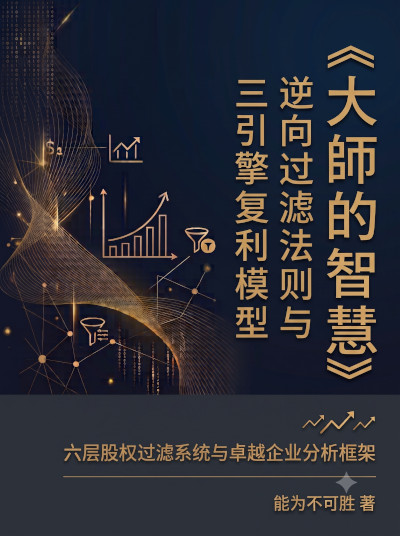
大师的智慧:逆向过滤法则与三引擎复利模型
前言:在数字时代,完成价值投资的代际升级
写下这些文字时,我怀着对本杰明·格雷厄姆先生、沃伦·巴菲特先生与查理·芒格先生等投资巨匠,以及无数行业先行者的深深敬意。
本书旨在解答困扰我多年的几个底层问题:如何将复利的数理逻辑,应用于企业微观的经营与财务实践中?哪些具体的运营驱动要素,才能真正转化为可持续的长期复利增长?卓越企业跨越周期的本质机制是什么?以及芒格先生所定义的“伟大企业”,在商业层面上究竟意味着什么?我们又能否将分散的经典投资理论融会贯通、交织成一套系统化的应用框架? 经过多年的研究与沉淀,我将这些思考系统地提炼为本书的结构化分析框架。
一、 投资的底层密码:认识复利的方程式
本书的立论,首先扎根于数理逻辑。在本书的第一部分,我选择以复利方程式作为整套体系的基石,深度剖析复利这一投资中极为关键的核心驱动力。复利并非虚无的哲学,而是由三大要素驱动的严密科学:
回报率:它体现了投资者在自身能力圈内的认知与投资水平。在合理且符合市场规律的范围内,回报率越高,资产积累的效率就越高。但回报率也是三大要素中最具挑战、最不可控的变量——追求的预期收益越高,驾驭它的难度与潜在风险便呈指数级上升。
时间:它是放大资产规模的关键要素。在风险可控的前提下,投资周期越长,复利的累积效应就越显著。即便未来不再追加新的资金投入,只要在合理的配置下给予足够的时间,原有的资产也有望在时间的催化下实现长期的价值增长。
本金:它是三大要素中唯一能够由投资者完全自主规划与掌控的变量。何时投入、投入多少,完全取决于个人的财务规划能力、进取心与意愿。
这三大要素不仅构成了投资的数理起点,更指向了一个终极结论:复利,是一场人生的修行。
芒格先生曾说,同时理解复利的力量和获得它的困难,是理解许多事情的核心和灵魂。复利的深远意义绝不限于单纯财富数字的增长。它更像一面镜子,促使我们深度审视自己:审视我们当下的知识储备、在职场中的核心定位、日常消费的真实态度、对待自身健康的重视程度,以及对未来的长远规划与执行。生活中的每一个切面,最终都会化作人生复利方程式里的本金、回报率与时间,深刻决定着我们人生的最终回报。一套合理的投资理念,不仅能在未来协助我们收获从容,更可能转化为一份可以传承的家族资产。
二、 经典哲学的现代认知鸿沟与规模边界的重塑
理解了复利的底层方程式后,接下来要解决的是具体的应用与标的甄别问题。然而我发现,经典的价值投资哲学与现代商业环境之间,存在着一条由于企业商业模式属性不同而难以跨越的认知鸿沟。
过去那些泛泛谈论高品质和护城河的传统书籍,容易让读者感到困惑:它们大多侧重于展示卓越企业的最终财务结果,却相对较少深度解剖物理规模扩张给传统企业带来的微观磨损。在复杂的商业现实世界中,规模的盲目扩张通常伴随着管理复杂度与摩擦系数的非线性上升,这往往意味着沉重的资本开支、失控的行政熵增以及难以逾越的物理半径陷阱。
然而,随着部分具备特定优势的传统企业演进与现代数字平台的崛起,出现了一批具有差异化特征的运营样本,它们尝试在底层机制上避开传统企业所面临的物理规模局限。
特别是部分数字平台,依靠低边际成本效应、标准化的数字化基础设施或者广泛的数字分发网络来实现业务扩张,展现出了一种差异化的商业模式。这类企业在扩张过程中,往往不需要严格按比例追加高昂的实体资产投入,而是有望凭借数字化基建的轻资产特征,在一定程度上有效缓解管理熵增与物理边界的约束。这有助于企业在尝试减弱庞大体量负面效应的同时,优化资产运作效率,从而为获取相对稳健的经营利润与自由现金流提供潜在的理论支撑。
面对这类新模式与传统视角的碰撞,市场上普遍存在着两种认知局限:
传统价值投资视角的局限:往往因为墨守成规,将注意力限制在低市净率、重资产的传统行业,未能洞察到新模式在避开规模约束层面的商业优势,从而错失了数字化时代优质企业的长期成长红利。 现代科技与商业分析的局限:大多只关注技术颠覆的宏大叙事与用户规模的表象增长,却对如何将这种抗规模效应的优势转化为资本配置纪律、股份回购与注销,以及每股收益(EPS)的长期复利增长机制,缺乏深刻的财务理解。 本书的目的,正是为了弥补这一鸿沟,带您看清卓越企业是如何在跨越规模约束的同时,启动真正的长期复利机器。
三、 大师智慧的逆向过滤法则与三引擎复利模型:向“价值投资三剑客”致敬
为了寻找现代企业商业模式与价值投资哲学的交汇点,本书在核心选股方法论上进行了一次极其重要的尝试——即通过向格雷厄姆先生、巴菲特先生与芒格先生这三位价值投资史上的传奇巨匠致敬,构建起本书方法论的精神铁三角。
全书共分为三个递进的核心部分:
第一部分:复利公式。深入探讨实现真正指数级增长所需的数理基础与底层机制。 第二部分:企业第一,市场第二。引入大师智慧的逆向过滤法则——这一心智模型受价值投资巨匠的启发,旨在帮助我们系统地识别并规避潜在的市场与企业经营风险。 第三部分:跨越规模瓶颈与三引擎复利模型。剖析制约企业扩张的物理与组织规模瓶颈,并展示能够成功绕过这些限制的商业模式。在此,我将推出“三引擎复利模型”——对伟大企业微观结构的终极拆解,并以此模型重新诠释伯克希尔的经典持股策略。随后,我们将该模型融汇于大师逆向过滤法则之中,将其升级为一套更完善的六层股权体系。
我必须真诚地坦言,本书之所以能够推演出“大师智慧的逆向过滤法则”与“三引擎复利模型”,其数理风控的根基完全发轫于格雷厄姆先生。正是格雷厄姆先生最早为世人揭示了安全边际的核心定义,并教导投资者将证券市场视作一个情绪化的集合体。他那立足于资产真实价值、审慎排查底层风险的绝对纪律,为本书设立六层股权过滤系统提供了最初的底层风控逻辑。
而在商业模式的洞察上,巴菲特先生数十年来通过致股东信等渠道分享的睿智见解,如同一道明亮的光芒,照亮了现代商业演进过程中的重重迷雾。正是由于巴菲特先生关于企业核心护城河的阐述、关于将资本配置视作核心管理艺术的理念,以及他数十年如一日深耕于自身能力圈的克制态度,才使我有可能在庞杂的商业表象下,审视并梳理出现代优质企业所特有的“三引擎复利模型”机制。若没有他长年累月对顶级无形资产和资本配置的深刻剖析,结合我在工作中常面临的软件规模化考验,我便较难看透特定企业跨越物理规模束缚的内在规律。
在此基础上,本书在执行层面的过滤器设计,其灵魂则完全承袭自芒格先生的逆向思考艺术。市面上绝大多数选股书籍的逻辑通常倾向于正向预测,试图去推测谁是明天的赢家;而芒格先生极力推崇的思维方式则是逆向思维——反过来想,总是反过来想!
本书中“大师智慧的逆向过滤法则”是一个六层过滤系统,正是格雷厄姆先生的安全边际底线、巴菲特先生的商业护城河洞察与芒格先生的逆向思考交融碰撞后的工程化落地。它的运转逻辑完全是逆向的:我们不倾向于盲目预测未来,而是通过严谨的财务与商业逻辑设立层层防护,主动、审慎地排查并剔除潜在的输家。正是在学习大师的过程中,我逐渐领悟到了芒格先生那句人生至理的真谛:不要去思考如何成功,而是先思考会导致失败的因素(如愚蠢、无知、违背规律)。当你排除了所有导致平庸和灾难的可能,剩下的必然是通往卓越的路径。
当我们在市场的喧嚣中,用这六层标准层层剥离掉容易产生投机的市场因素、资产泡沫领域、高迭代且不确定性极高的技术黑箱、具有较大阶段性毁灭风险的剧烈周期博弈,以及无法为股东提供稳定自由现金流回报的重资产企业时——那些经历大浪淘沙、被我们过滤剩下的极少数企业,便成为了具备较强竞争壁垒的优质选择。
在特定的商业假设下,它们通常共同具备以下三大核心驱动引擎:
第一引擎(经营端):轻资产扩张——通过经营杠杆与外部资源撬动,突破物理资产束缚并破解规模不经济;
第二引擎(模式端):自动通胀红利——依靠强定价权与名义交易额增长,实现跨越周期的天然抗通胀与时间复利;
第三引擎(资本端):增值型股东回报——将充沛的自由现金流高效配置于系统性分红与择机股份回购注销,从每股维度推动价值的持续复合增长。
在每股收益(EPS = 净利润 ÷ 总股本)的数理模型中,这三大引擎展现出了清晰的逻辑分工:
第一引擎与第二引擎专注于分子端:通过轻资产模式带来的高经营杠杆,使企业在免受规模不经济的前提下实现拓展;同时,凭借与物理生产成本解耦的定价机制(如数字广告领域的动态注意力竞价系统),推动高利润率以及具备抗通胀属性的收入端增长。
第三引擎驱动分母端优化与股东直接增值: 专注于自由现金流的高效资本配置。通过持续的股份回购注销直接缩减总股本(分母),对 EPS 产生长效的杠杆放大效应;或者通过有纪律的分红派息,将分子端成果直接转化为股东的现金收益,打通资本回报的最终闭环。
优质的商业模式通常表现为对外部资本的依赖度较低,或者能够以较高的资本效率利用外部资本。这类商业实体在其底层的运作机制中通常自带高经营杠杆,尤其是以特定数字平台为代表的轻资产范式。在跨越了初始的规模边界与完成市场验证后,未来的规模扩张非但不会成为其发展的瓶颈,反而能够持续释放出规模效应。这为企业在运营过程中产生相对充沛的自由现金流提供了坚实的财务基础,也为企业在特定发展阶段通过持续回购股票来优化分母结构、推动每股收益的长期演进提供了差异化的价值保障。对这类企业而言,时间是极其强大的战略同盟。即便投资者在今天支付了合理的价格,企业卓越的资本效率与复利增长,也更有可能在长期持有中为耐心资本带来稳健的回报。
四、 终点亦是起点:给长期资本的礼物
“大师智慧:逆向过滤法则与三引擎复利模型”代表了这一探索之旅的结晶——为我最初试图解决的问题,提供了一个具体且可重复的答案。
这些文字,原本只是我梳理自己过往投资体悟的个人笔记,打算作为一份参考资产留给家族后代。后来,在与 Gemini 人工智能交互系统进行多维度对话的过程中,系统给出的客观分析与系统反馈让我深受触动,也让我最终下定决心将这本书整理出版,分享给更多在投资路上探索的朋友。
最后,向各位读者进行真真切切的风险提示:本书所涉及的所有模型推演、历史数据与经典案例分析,均属于特定历史阶段的财务逻辑探讨与学术性归纳,旨在分享投资认知,并不构成对未来任何确定性收益的保证,亦不构成具体的个股投资买卖建议。股市有风险,投资需谨慎。
愿我们在领受这份智慧的旅程中,理性思考,保持对长期价值的希冀,稳步前行。